(619) 465-4880

If you want a stronger back, better balance, and real-world strength, stop thinking about “abs” and start thinking about your core as a 360-degree cylinder. Your core wraps around you front to back and top to bottom. It includes your diaphragm up top, pelvic floor below, and the deep stabilizers and obliques that cinch around your trunk. Training that whole cylinder is very different from doing endless crunches.
1) Your spine prefers stability from all sides.
Quality core programs build anti-extension, anti-rotation, and anti-lateral-flexion control. That means your trunk learns to resist unwanted motion so your hips and shoulders can move powerfully and safely. Clinical and sports literature consistently favors these stability patterns with exercises like dead bugs, bird dogs, side planks, chops, lifts, and Pallof presses for performance and injury reduction. PMC
2) Crunches load the spine in ways many backs do not love.
Classic sit-ups and high-rep spinal flexion can create large compressive and shear forces on lumbar discs. Biomechanics work from spine researchers has shown disc strain with repeated flexion cycles, which helps explain why many people’s low backs flare with old-school ab routines. That does not mean a single set of crunches will injure you, but it does underscore why a stability-first approach is smarter for most people. University of Waterloo+1
3) Bracing outperforms “sucking in.”
Remember the old cue to “draw your belly button to your spine”? That’s abdominal hollowing. Newer evidence points to abdominal bracing—creating circumferential tension, like tightening a 360-degree belt—as more effective for global trunk stability and functional carryover. Controlled trials and reviews show bracing recruits a broader network of abdominal muscles than hollowing and is often superior for tasks that need stiffness, strength, and protection. PMC+2PMC+2
4) Training the trunk in 3D changes how you move.
Programs that challenge the trunk in multiple planes improve strength, gait, agility, and knee loading mechanics more than simple ab-isolating moves. That matters for athletes and for everyday life, from lifting groceries to hiking. Randomized trials in different populations show benefits when trunk stability is trained with quasistatic or three-dimensional strategies. PubMed+1
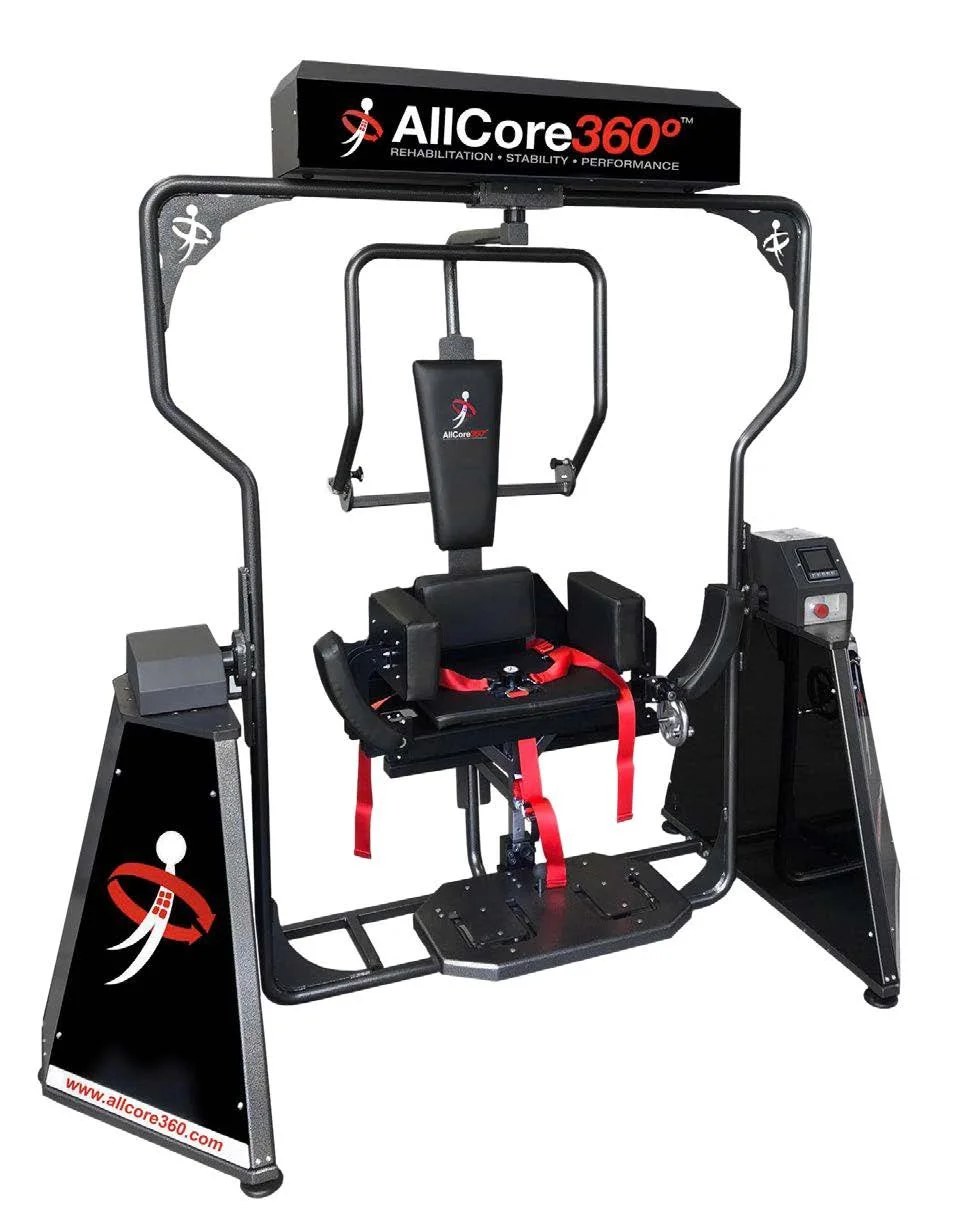
Our Alpine clinic offers the AllCore360°, a motorized, rotating chair that challenges your core through controlled inclines and 360-degree rotation. Here’s why that matters:
Are crunches always “bad”? Not necessarily. In some programs, low-volume, well-coached spinal flexion can be safe for the right person. But for many backs, especially those with sensitivity to flexion, a stability-dominant, 360-degree strategy delivers the benefits most people actually want: less pain, more control, and better carryover into life. If you do choose to include flexion work, keep the reps modest, respect recovery, and make sure it does not aggravate your symptoms. University of Waterloo
Training your core like a 360-degree cylinder aligns with how your body stabilizes the spine in real life. It is more transferable to sport and daily tasks than high-rep crunch routines, and it respects the spine’s tolerance to load. The AllCore360° lets us apply that cylinder concept in a precise, progressive, and measurable way, so you feel the difference in how you stand, move, and perform. PMC+1
Ready to experience 360-degree core training?
Book a session at Awesome Family Chiropractic’s Alpine clinic to try the AllCore360°. Ask about our complimentary first ride slots this month and we’ll see what true cylinder bracing feels like in your body.
This blog is for educational purposes only and not a substitute for professional medical advice. Consult a healthcare provider before starting any new treatment. Outcomes and experiences discussed may vary. For immediate medical concerns, contact your physician.

info@awesomefamilychiropractic.com
La Mesa:
Mon: 9am-12:30pm, 2:30pm-6:30pm
Tues: Closed
Wed: 9am-12:30pm, 2:30pm-6:30pm
Thurs: 10am-1pm, 3pm-4pm
Fri: 9am-1pm, 2pm-4pm
Alpine:
Mon: 2:30pm-6pm
Tues: 9am-1pm, 2pm-4:15pm
Wed: 9am-1pm, 2pm-6pm
Thurs: 9am-1pm, 2pm-6pm
Fri: Closed
Santee:
Mon: 9am-1pm, 2pm-6pm
Tues: 9am-1pm, 2pm-6pm
Wed: 9:30am-1pm, 2pm-6pm
Thurs: Closed
Fri: 12pm-4pm